
Friday, April 30, 2010

Wednesday, April 21, 2010
Week 14: Day One
We did a review for the final test today in class. Students each took a chapter and wrote a series of questions around that chapter. We had some time at the end of class to do a competition pitting one side of the room against the other answering the questions.
I went over the top visual argument papers which I will post here for your review. The visual argument was accompanied by a letter to the instructor in which the student had to evaluate the visual argument that was made. The questions the students were to address were the following:
Erica's Bystander Effect PowerPoint
Here is Carly's PowerPoint on Ritalin
Check out Mckenzee's PowerPoint
Last but not least is Rolando's PowerPoint on Carbon Credits
I went over the top visual argument papers which I will post here for your review. The visual argument was accompanied by a letter to the instructor in which the student had to evaluate the visual argument that was made. The questions the students were to address were the following:
Erica's Bystander Effect PowerPoint
Erica b's paper 3 visual argument
View more presentations from BolducSimpson.
Here is Carly's PowerPoint on Ritalin
Carly hamilton s_paper_3_visual_argument
View more presentations from BolducSimpson.
Check out Mckenzee's PowerPoint
Revised mckenzee stephens paper_3_final
View more presentations from BolducSimpson.
Last but not least is Rolando's PowerPoint on Carbon Credits
Thursday, April 15, 2010
Week 13 Day Two
Today's online class assignment was a blog post....the last one. I chose to assign the Gordon Parks essay called Flavio's Home. It is one of my favorite pieces in The Longman Reader. Gordon Parks was not only a journalist, but a photographer as well. I found a picture of Flavio on the internet. Here it is.

Here are the directions to the post. The students had to respond to two questions.
This is a photo taken by Gordon Parks of Flavio. This picture says it all. In two paragraphs summarize the essay by Gordon Parks entitled Flavio's Home and then write a personal response to the essay.
2. The problem of poverty has provoked a wide array of proposed solutions. One controversial proposal argues that the government should pay poor women financial incentives to use birth control. Argue for or against this proposal, state at least two reasons with supporting evidence. Be sure and cite any sources you use.
There were many excellent response to the post. Below is Valerie's post.

In my opinion, poverty is probably the saddest thing in the world. It breaks my heart to hear about a family like Flavio's with barely any food and with sick siblings. Sometimes I wish I could save them all at the same time, but it is very hard. People do not realize what they take for granted. People think they need new clothes every week, new shoes, their nails and hair done, and etc. But they do not realize that there are people out there who need food and shelter to survive. I wish people all around the world could help end poverty so that there would be less families like Flavio's.
2. I understand that the problem of poverty has provoked a wide array of proposed solutions and that one controversial proposal argues that the government should pay poor women financial incentives to use birth control, but I disagree with this solution. I do not think it is right that women are not allowed to have as many kids as they want. It is their body, and they should be able to do whatever they want with it. I read in an article that "The Women's Health & Justice Initiative and the New Orleans Women's Health Clinic condemn Representative John LaBruzzo's recent legislative plans to pay poor women to get sterilized and reward rich, educated people to have children. The sterilization policy currently being advocated by Representative LaBruzzo is a blatant form of reproductive violence and population control policies of blame and disenfranchisement, rooted in this country's long and continual history of eugenics." How can people do this to humanity? These people seem like people who would be for abortion. This is very wrong.
"A Feminist Response to LaBruzzo's Sterilization Plan
A Katrina Reader." Challenging White Supremacy Workshop Home Page. Web. 15 Apr. 2010. .

This is a photo taken by Gordon Parks of Flavio. This picture says it all. In two paragraphs summarize the essay by Gordon Parks entitled Flavio's Home and then write a personal response to the essay.
2. The problem of poverty has provoked a wide array of proposed solutions. One controversial proposal argues that the government should pay poor women financial incentives to use birth control. Argue for or against this proposal, state at least two reasons with supporting evidence. Be sure and cite any sources you use.
There were many excellent response to the post. Below is Valerie's post.

"Creating Hope and Opportunity in Haiti for Extremely Poor Women and Their Families." BRAC Blog. Web. 15 Apr. 2010. .
1. The essay by Gordon Parks entitled Flavio's Home is about him visiting a favela in Brazil named Catacumba and meets a 12 year old boy named Flavio de Silva who changes his life. Parks visits this favela to interview a father with a family who is in poverty. They interviewed what he is going through and his beliefs on his situation. During their time there, they meet the 12 year old boy, Flavio, and they had a feeling that this boy would have a better story than any other father, because his legs were like sticks that were just screwed into his ankles. Parks and his partner visited Flavio's family and realized that Flavio's health was really bad. They took him to the clinic to try to get a doctor to help him but Flavio had sypmtoms of bronchial asthma, malnutrition and tuberculosis, which didn't give him much longer to live.In my opinion, poverty is probably the saddest thing in the world. It breaks my heart to hear about a family like Flavio's with barely any food and with sick siblings. Sometimes I wish I could save them all at the same time, but it is very hard. People do not realize what they take for granted. People think they need new clothes every week, new shoes, their nails and hair done, and etc. But they do not realize that there are people out there who need food and shelter to survive. I wish people all around the world could help end poverty so that there would be less families like Flavio's.
2. I understand that the problem of poverty has provoked a wide array of proposed solutions and that one controversial proposal argues that the government should pay poor women financial incentives to use birth control, but I disagree with this solution. I do not think it is right that women are not allowed to have as many kids as they want. It is their body, and they should be able to do whatever they want with it. I read in an article that "The Women's Health & Justice Initiative and the New Orleans Women's Health Clinic condemn Representative John LaBruzzo's recent legislative plans to pay poor women to get sterilized and reward rich, educated people to have children. The sterilization policy currently being advocated by Representative LaBruzzo is a blatant form of reproductive violence and population control policies of blame and disenfranchisement, rooted in this country's long and continual history of eugenics." How can people do this to humanity? These people seem like people who would be for abortion. This is very wrong.
"A Feminist Response to LaBruzzo's Sterilization Plan
A Katrina Reader." Challenging White Supremacy Workshop Home Page. Web. 15 Apr. 2010. .
Wednesday, April 14, 2010
Week 13 Day One
Today's lesson was based on an essay by Star Parker called Se Habla Entitlement. This essay focuses on the claim that illegal immigrants have no rights or entitlements in the United States, and they are a strain on U.S. society.
This author's rhetorical stance is in sharp contrast to Roberto Rodriguez's essay The Border on Our Backs. Rodriguez claims that illegal immigrants should no longer accept the second-rate status they have been allotted in the United States.
Here is a YouTube video that had 3 million hits. You will see why it is so good.
Both essays were opinion pieces targeted for a sympathic audience. I had as an activity to do a debate on a slightly different proposition:
Should America maintain/increase the level of legal immigration?
The class was divided up into pairs with each pair given a pro or con reason. I got the argument from a great site called Balanced Politics. It can be found at http://www.balancedpolitics.org/
From that site, the Pro and Con Arguments were as follows:
PRO
1. Some of the most intelligent and ambitious individuals, who are unsatisfied with their own countries bring skills to America.
2. It increases the diversity and expands the culture of the country.
3. immigrants often take the low-paying jobs( like food service and hotel cleaning) that most Americans don't want to do at such low wages.
4. Decreasing or eliminating legal immigration will inevitably create more incentive to come to the country illegally, which leads to less assimilation and fewer taxpaying, law abiding citizens.
5. It improves the overall image of America internationally, as it is seen as an open, welcoming country; and immigrants who return home or maintain contact with family back home have a true image of America, not the one propagandized in much of the international media.
6. Adding an additional group of cheap labor adds to the flexibility of business, leading to cheaper prices, better quality products, and higher profits.
7. It gives struggling people all over the world an opportunity for a better life. This country was built on immigrants who sought opportunity, political and religious freedom.
CONS
1. More immigrants means more opportunity for terrorists, drug dealers, and other criminals to enter the country.
2. Immigrants, especially the poorer ones, consume a high amount of government resources (health care, education, welfare, etc.) without paying a corresponding high rate of taxes.
3. The national identity and language is disappearing. The great "melting pot" is being replaced by divisive multi-culturalism.
4. The emigration to the United States hurts the home country, as much of the male population, workers, and top intellectuals often leave their country.
5. Less skilled citizens earn less money and have fewer job opportunities because they must compete with immigrants in the job market.
Alex and Tim provided excellent evidence to back up their pro argument related to business.
Ryan and Rikki provided examples of citizens being forced to take low paying jobs by providing examples of Disney and the cruise ship industry but failed to go into detail. I had heard that Disney was a great company to work for in terms of benefits. I would have liked information on the salary ranges.
Brittany and James provided lots of stats using the Pew Research Center survey.
Rolando and Kasie also provided lots of stats on the con side of the argument.
Carly and Valeria actually found the balancedpolitics.org site and copied the information related to their pro argument. I was hoping the students wouldn't find the site because the site goes into detail on each of the reasons.
Okay, so this perfectly planned lesson that I imagined would ignite the masses to engage in a fiery debate fizzled. I know why.....I was micromanaging the whole thing by critiquing each person's evidence in the attempt to teach how evidence should be collected and presented.
The next time I do this kind of thing, the students will have a presentation of how evidence should be linked to reasons in a claim. I put the cart before the horse. Therefore, the whole activity became a chore. I didn't allow the cons to say anything. What I should have done was to have one pro present, followed by a rebuttal and then a con, then a rebuttal, a pro, etc.
The students were trying to engage in the debate and I held them off.
I think the activity is a good one. The procedure needs work. In the process, I found that great balanced politics website. I noticed that lots of students wrote down the link, so that was good for any students writing in other classes.
Two more weeks of classes. I think everyone is tired. Alas...always pidgeons in the grass.
This author's rhetorical stance is in sharp contrast to Roberto Rodriguez's essay The Border on Our Backs. Rodriguez claims that illegal immigrants should no longer accept the second-rate status they have been allotted in the United States.
Here is a YouTube video that had 3 million hits. You will see why it is so good.
Both essays were opinion pieces targeted for a sympathic audience. I had as an activity to do a debate on a slightly different proposition:
Should America maintain/increase the level of legal immigration?
The class was divided up into pairs with each pair given a pro or con reason. I got the argument from a great site called Balanced Politics. It can be found at http://www.balancedpolitics.org/
From that site, the Pro and Con Arguments were as follows:
PRO
1. Some of the most intelligent and ambitious individuals, who are unsatisfied with their own countries bring skills to America.
2. It increases the diversity and expands the culture of the country.
3. immigrants often take the low-paying jobs( like food service and hotel cleaning) that most Americans don't want to do at such low wages.
4. Decreasing or eliminating legal immigration will inevitably create more incentive to come to the country illegally, which leads to less assimilation and fewer taxpaying, law abiding citizens.
5. It improves the overall image of America internationally, as it is seen as an open, welcoming country; and immigrants who return home or maintain contact with family back home have a true image of America, not the one propagandized in much of the international media.
6. Adding an additional group of cheap labor adds to the flexibility of business, leading to cheaper prices, better quality products, and higher profits.
7. It gives struggling people all over the world an opportunity for a better life. This country was built on immigrants who sought opportunity, political and religious freedom.
CONS
1. More immigrants means more opportunity for terrorists, drug dealers, and other criminals to enter the country.
2. Immigrants, especially the poorer ones, consume a high amount of government resources (health care, education, welfare, etc.) without paying a corresponding high rate of taxes.
3. The national identity and language is disappearing. The great "melting pot" is being replaced by divisive multi-culturalism.
4. The emigration to the United States hurts the home country, as much of the male population, workers, and top intellectuals often leave their country.
5. Less skilled citizens earn less money and have fewer job opportunities because they must compete with immigrants in the job market.
Alex and Tim provided excellent evidence to back up their pro argument related to business.
Ryan and Rikki provided examples of citizens being forced to take low paying jobs by providing examples of Disney and the cruise ship industry but failed to go into detail. I had heard that Disney was a great company to work for in terms of benefits. I would have liked information on the salary ranges.
Brittany and James provided lots of stats using the Pew Research Center survey.
Rolando and Kasie also provided lots of stats on the con side of the argument.
Carly and Valeria actually found the balancedpolitics.org site and copied the information related to their pro argument. I was hoping the students wouldn't find the site because the site goes into detail on each of the reasons.
Okay, so this perfectly planned lesson that I imagined would ignite the masses to engage in a fiery debate fizzled. I know why.....I was micromanaging the whole thing by critiquing each person's evidence in the attempt to teach how evidence should be collected and presented.
The next time I do this kind of thing, the students will have a presentation of how evidence should be linked to reasons in a claim. I put the cart before the horse. Therefore, the whole activity became a chore. I didn't allow the cons to say anything. What I should have done was to have one pro present, followed by a rebuttal and then a con, then a rebuttal, a pro, etc.
The students were trying to engage in the debate and I held them off.
I think the activity is a good one. The procedure needs work. In the process, I found that great balanced politics website. I noticed that lots of students wrote down the link, so that was good for any students writing in other classes.
Two more weeks of classes. I think everyone is tired. Alas...always pidgeons in the grass.
Monday, April 12, 2010
Thursday, April 8, 2010
Week 12 Day Two
Blog Post 4 was today's assignment. Here are the directions:
Answer BOTH questions.
1. Martin Luther King in his essay, Where Do We Go From Here: Community or Chaos? that we mount a peace initiative. Outline your plan to transform the nuclear arms race into a peace race. Research peace intiatives to support your argument. Be sure and cite your source.
2. Martin Luther King in his essay World House talks about "bridging the gulf between our scientific progress and our moral progress." Explain the two realms he speaks about (p.598)and suggest how we, as a nation, can balance our scientific and technological abundance with living a moral and spiritual life.
NOTE: include a graphic (with citation if you don't use a royalty free one) and/or YouTube video with your post.
I noticed that the students have been making dramatic improvement in the quality of their posts, incorporating sources, great insights, and attending to the grammar and mechanics. The one thing I have had to remind them of is to cite their sources and, in particular, their graphics.
Here is the featured blog post of the week from McKenzee is reflects deeply on everything and always rises to the challenge.
1. The question for this topic is hard to answer, I see peace not exactly the same as the book described. In today’s society even in the past, we try to create a peaceful world. History in books and movies describe peaceful as a world such as Utopia, the beautiful, the impossible. This world has not and will not ever exist. With today’s technology and new creations I don’t think the world will ever get rid of the nuclear demons they have created. I think America as well as the other nations are too busy competing with one another about the future that they forget to focus on the present. Well, news flash the present determines the future. Instead of focusing on disarming the nuclear weapons we should focus on other things, a tactic that America has been using is the threat of nuclear retaliation in the event of conflict, instead of actually enforcing it. This defense has helped keep governments throughout the world in check. Although there are many smaller conflicts around the world, we have not seen anything approaching a “World War” in over fifty years. i believe that the U.S. strategy on nuclear weapons has helped to promote this limited warfare into smaller regional scrimmages that are going on today. It is only the threat of these weapons that we can maintain a strong defense to keep as peaceful of a world as possible. The sinful nature of man is in direct contradiction to peaceful existence. For over two thousand years man has been at war with itself, and to think the elimination of nuclear weapons will create an Utopia of peace is fool -hardy.
http://www.nuclearfiles.org/menu/key-issues/missile-defense/history/reagan_on-strategic-defense-iniative.htm
2. We are making advances in science to the point that we have to ask ourselves, “Is this morally correct, even though we have the power to do something should we do it?” In Martin Luther King’s essay he explains that there is two ways in which everyone lives, internally and externally. The internal deals with morality and separating what right and what’s wrong. External deals with the materialistic and scientific progress. He explains that we are living too much of an external life that we are losing our internal life. We are losing our morality. This is hard to create a balance and has always been an issue. Stem cell research is just one example of many topics that relate to internal and external decisions. I think the only way we can create a balance of each is to have meetings of debates. Let the debates point of the pro and cons to each and if it passes, set certain rules and regulations for each advance taken. I think we should have a “watch dog” group specially assigned to each scientific or technological advance to make sure each is not exceeding to interfere with morality.
Answer BOTH questions.
1. Martin Luther King in his essay, Where Do We Go From Here: Community or Chaos? that we mount a peace initiative. Outline your plan to transform the nuclear arms race into a peace race. Research peace intiatives to support your argument. Be sure and cite your source.
2. Martin Luther King in his essay World House talks about "bridging the gulf between our scientific progress and our moral progress." Explain the two realms he speaks about (p.598)and suggest how we, as a nation, can balance our scientific and technological abundance with living a moral and spiritual life.
NOTE: include a graphic (with citation if you don't use a royalty free one) and/or YouTube video with your post.
I noticed that the students have been making dramatic improvement in the quality of their posts, incorporating sources, great insights, and attending to the grammar and mechanics. The one thing I have had to remind them of is to cite their sources and, in particular, their graphics.
Here is the featured blog post of the week from McKenzee is reflects deeply on everything and always rises to the challenge.
1. The question for this topic is hard to answer, I see peace not exactly the same as the book described. In today’s society even in the past, we try to create a peaceful world. History in books and movies describe peaceful as a world such as Utopia, the beautiful, the impossible. This world has not and will not ever exist. With today’s technology and new creations I don’t think the world will ever get rid of the nuclear demons they have created. I think America as well as the other nations are too busy competing with one another about the future that they forget to focus on the present. Well, news flash the present determines the future. Instead of focusing on disarming the nuclear weapons we should focus on other things, a tactic that America has been using is the threat of nuclear retaliation in the event of conflict, instead of actually enforcing it. This defense has helped keep governments throughout the world in check. Although there are many smaller conflicts around the world, we have not seen anything approaching a “World War” in over fifty years. i believe that the U.S. strategy on nuclear weapons has helped to promote this limited warfare into smaller regional scrimmages that are going on today. It is only the threat of these weapons that we can maintain a strong defense to keep as peaceful of a world as possible. The sinful nature of man is in direct contradiction to peaceful existence. For over two thousand years man has been at war with itself, and to think the elimination of nuclear weapons will create an Utopia of peace is fool -hardy.
http://www.nuclearfiles.org/menu/key-issues/missile-defense/history/reagan_on-strategic-defense-iniative.htm
2. We are making advances in science to the point that we have to ask ourselves, “Is this morally correct, even though we have the power to do something should we do it?” In Martin Luther King’s essay he explains that there is two ways in which everyone lives, internally and externally. The internal deals with morality and separating what right and what’s wrong. External deals with the materialistic and scientific progress. He explains that we are living too much of an external life that we are losing our internal life. We are losing our morality. This is hard to create a balance and has always been an issue. Stem cell research is just one example of many topics that relate to internal and external decisions. I think the only way we can create a balance of each is to have meetings of debates. Let the debates point of the pro and cons to each and if it passes, set certain rules and regulations for each advance taken. I think we should have a “watch dog” group specially assigned to each scientific or technological advance to make sure each is not exceeding to interfere with morality.
Tuesday, April 6, 2010
Week 12 Day One
What a great morning we had with our lesson related to Leslie Savan's essay Black Talk and Pop Culture.
We had an arts and crafts day with the students taking on the vernaculars of different groups in America and creating a poster of vocabulary which has been incorporated into American talk from that group. Here are the directions for the task:
DO YOU SPEAK AMERICAN?
ROLES: RESOURCE PERSON
POSTER MAKER
PRESENTER
Directions:
a. Work in your group to do some research on a vernacular of a particular group of people by clicking on the links below.
b. Create a poster of the words used in the vernacular assigned to you.
c. The words should accompany definitions and be those that have crept into the English language.
d. Print out pictures to add to your poster. Use the markers to make the poster visually appealing.
e. Provide any background of the origin of the words in your group presentation.
1. SPANGLISH: http://www.npr.org/templates/story/story.php?storyId=1438900
2. YIDDISH: http://www.dailywritingtips.com/the-yiddish-handbook-40-words-you-should-know/
3. TEXAN: http://donnasue.net/How_to_Talk_Proper_Texan.html
4. BOSTONIAN: http://www.universalhub.com/glossary
http://www.universalhub.com/glossary/a-b
5. CAJUN TALK: http://www.suite101.com/article.cfm/cajun_culture/33756
http://pages.cs.wisc.edu/~jmeaux/cajundict.html
6. AMERICAN INDIAN WORDS: http://www.infoplease.com/spot/aihmwords1.html
7. NEW YORK CITY TALK: http://www.associatedcontent.com/article/47164/new_york_city_vernacular_slang_and.html?cat=9
The posters were all good. After I got the students to stop limiting themselves to how they were to make the poster, they went to town. Here are a few of their products.


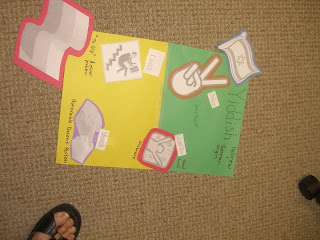


We had an arts and crafts day with the students taking on the vernaculars of different groups in America and creating a poster of vocabulary which has been incorporated into American talk from that group. Here are the directions for the task:
DO YOU SPEAK AMERICAN?
ROLES: RESOURCE PERSON
POSTER MAKER
PRESENTER
Directions:
a. Work in your group to do some research on a vernacular of a particular group of people by clicking on the links below.
b. Create a poster of the words used in the vernacular assigned to you.
c. The words should accompany definitions and be those that have crept into the English language.
d. Print out pictures to add to your poster. Use the markers to make the poster visually appealing.
e. Provide any background of the origin of the words in your group presentation.
1. SPANGLISH: http://www.npr.org/templates/story/story.php?storyId=1438900
2. YIDDISH: http://www.dailywritingtips.com/the-yiddish-handbook-40-words-you-should-know/
3. TEXAN: http://donnasue.net/How_to_Talk_Proper_Texan.html
4. BOSTONIAN: http://www.universalhub.com/glossary
http://www.universalhub.com/glossary/a-b
5. CAJUN TALK: http://www.suite101.com/article.cfm/cajun_culture/33756
http://pages.cs.wisc.edu/~jmeaux/cajundict.html
6. AMERICAN INDIAN WORDS: http://www.infoplease.com/spot/aihmwords1.html
7. NEW YORK CITY TALK: http://www.associatedcontent.com/article/47164/new_york_city_vernacular_slang_and.html?cat=9
The posters were all good. After I got the students to stop limiting themselves to how they were to make the poster, they went to town. Here are a few of their products.


Valerie, Brittany, Tim Poster

McKenzee, Jennifer, Kaydee Poster

Ryan, Rikki, and Kelles Poster

Jared, Clay, Rolando Poster

Alex, Kasie, Laura Poster

Tom and Ben Poster

Erika, Nick, and James Poster
As you can see, everyone seemed engaged with this activity and seemed to be having fun. Moreover, in the presentations afterwards, the class learned about other groups. Some didn't know what Creole was or where Cajun came from. Alex gave us a lesson on Bostonian talk, while Jared talked about the origins of Yiddish.
I was pleased with the way the lesson went. Only wish I had time to do the journal free write on hip hop language from the YouTube I found. Check it out.


Sunday, April 4, 2010
Week 11 Days One and Two
This week I was in San Diego for the 2010 Society for Information Technology & Teacher Education. My husband, Mark Simpson, and I attended lots of great presentations and also presented a poster session entitled I Think, You Think: Teacher-Student Reflections Using Free Online Technologies. Below are some photos of our presentation.


We learned lots and can't wait to apply some of it in our classes.
In the meantime, my Creative Composers were busy at work peer editing one another's visual argument papers and submitting their first drafts of their letters to me in which they evaluated their visual arguments.
This assignment needed much more guidance as the majority of the students used too much text in their argument. I will take some time on Monday to go over the problems. They will have about 10 days to do their final drafts.
The end of the semester is coming upon us quickly.
Wednesday, March 24, 2010
Week 10 Day Two
Blog Post 3 dealt with the subject of stereotypes and restricted definitions. The directions to the post were as follows:
William Rasberry in his essay The Handicap of Definition makes a plea for providing the younger generation with a more postive, more expansive definition of black.
Answer the two questions below:
1. Do research on another ethnic group which carries with it a limited definition of that group (e.g., Australian, German, Arab, Chinese, etc). How is that group stereotypically defined? What can teachers, parents, and society at large do to impart to the younger generation positive and more expansive definitions of ethnic groups?
2. Like most people, you or someone you know had had a "defining" term applied to you at one time or another. Perhaps you've been called "shy" or "stubborn" or "the class clown" or "the athlete of the family." Focusing on one such label that's been applied to you, explain the effects that this labeling has had on your life.
Don't forget to comment on at least two of your peers' posts.
Even though not all the posts are in, I liked Nick M's post on Greek stereotypes and his personal reflection on being looked down because he was a golfer.

1. The Greek culture interests me because that is the majority of my background, but being Greek in times like these is not very easy. As many know who watch the news, they know that in Athens, the capital of Greece, there is absolute chaos going on. You can start to see stereotypes being thrown around because the economy in Greece is terrible. I have heard many people say that Greeks have olive oil skin, or are too cocky because they think that they invented everything. Many people are laughing at the Greeks now saying that they are ignorant and can't even support their own economy, but yet look at the economy of the U.S. People everywhere are always going to look down on people of different cultures, but in reality everyone is the same.
I think that the best thing that teachers could do would be to show students the positive parts of every culture. Then the students can associate their classmates with positive thinking. If students are taught young to associate good thoughts with other cultures, then maybe there will be more acceptance in our future society and racism will be cut down to a minimum.
William Rasberry in his essay The Handicap of Definition makes a plea for providing the younger generation with a more postive, more expansive definition of black.
Answer the two questions below:
1. Do research on another ethnic group which carries with it a limited definition of that group (e.g., Australian, German, Arab, Chinese, etc). How is that group stereotypically defined? What can teachers, parents, and society at large do to impart to the younger generation positive and more expansive definitions of ethnic groups?
2. Like most people, you or someone you know had had a "defining" term applied to you at one time or another. Perhaps you've been called "shy" or "stubborn" or "the class clown" or "the athlete of the family." Focusing on one such label that's been applied to you, explain the effects that this labeling has had on your life.
Don't forget to comment on at least two of your peers' posts.
Even though not all the posts are in, I liked Nick M's post on Greek stereotypes and his personal reflection on being looked down because he was a golfer.

1. The Greek culture interests me because that is the majority of my background, but being Greek in times like these is not very easy. As many know who watch the news, they know that in Athens, the capital of Greece, there is absolute chaos going on. You can start to see stereotypes being thrown around because the economy in Greece is terrible. I have heard many people say that Greeks have olive oil skin, or are too cocky because they think that they invented everything. Many people are laughing at the Greeks now saying that they are ignorant and can't even support their own economy, but yet look at the economy of the U.S. People everywhere are always going to look down on people of different cultures, but in reality everyone is the same.
I think that the best thing that teachers could do would be to show students the positive parts of every culture. Then the students can associate their classmates with positive thinking. If students are taught young to associate good thoughts with other cultures, then maybe there will be more acceptance in our future society and racism will be cut down to a minimum.
2. My entire life I have loved the game of golf. Many people saw this sport as a easy sport, or something that required no athleticism. I always used to be ashamed to tell my friends that I was going golfing, or going to practice. I decided once I got to high school that I wanted to do something with the game I love, so I gave up on what people thought. All my true friends didn't bother me about it, and I took my game to a whole new level. Now that I have a pro card, I look back at all the kids that made fun of me and smile knowing that I am a pro athlete.
Week 10 Day One
We discussed the subject of surveys and Gen Nexters (born in the 1980s)from the reading by Ann Hulbert called Beyond the Pleasure Principle . The activity was to replicate a Pew Research Center study done in 2006 on values, behaviors and issues of Gen Nexters.
I sent the students out with the task to interview 3 people on campus (preferably people in the Gen Nexter age range) and ask them five questions. The questions were as follows:
1. Do you support gay marriage?
2. Do you support privatization of the Social Security system?
3. Do you believe it is yur duty as a citizen to vote?
4. Do you agree with the statement that technological tools make people lazier?
5. Do you agree with the statement that the growing number of immigrants in the U.S. strengthens our country.
With approximately 65 respondants, the results were tallied with Alex in charge of figuring out the best procedure for tabulation.
1. 64% supported gay marriage.
2. 47% supported the privatization of the Social Security system.
3. 90% agreed with the statement that it is your duty as a citizen to vote.
4. 58% agreed with the statement that technological tools make people lazier.
5. 18.5% of the respondants agreed with the statement that the growing number of immigrants in the U.S. strengthens our country.
We discussed the discrepancies with the statistics in the Pew Research Center study looking at the different variables, such as the demographics and the currency of the study.
The biggest difference was on Question 5 regarding immigrants strengthening our country (18.5% compared to 50% in the Pew study). We briefly talked about the high immigrant population in Florida and the issues related to employment and education. Although I wasn't terribly surprised that the survey revealed that the majority of students on the FGCU campus don't agree that immigrants strengthen our country, it brought home the point that we need to address the issue of diversity and spread awareness of what a diverse population can contribute to our nation.
This would make a good claim to use in an argument using the Rogerian pattern of argument to help students see the various perspectives on this topic.
We still had 15 minutes left in the period. I had talked about the i-Generation and planned to show the video clip below but the sound wasn't working. Instead, the students had to google the characteristics of the i-generation and form three questions regarding the values, behaviors, or issues of this generation and form their questions to try and elicit the differences between the Nexters and the i-generation.
A couple of questions posed in the discussion forum were:
(Carly's Questions)
1. Was either your first or second cell phone a smartphone?
2. Did/Do you have a facebook in middle school?
3. Have you ever used dial up Internet connection?
(Jennifer's Questions)
1. Were you in elementary school when you recieved your first cell phone?
2. Were you younger than 15 when you joined your first social net-working website?
3. Do you use a PDA for more of a research data base than your own computer?
In a way, I'm glad that the video didn't work, because it allowed time for tdiscussion of the differences between the i-generation and the Gen Nexters.
Here is the video clip I wanted to show.
I sent the students out with the task to interview 3 people on campus (preferably people in the Gen Nexter age range) and ask them five questions. The questions were as follows:
1. Do you support gay marriage?
2. Do you support privatization of the Social Security system?
3. Do you believe it is yur duty as a citizen to vote?
4. Do you agree with the statement that technological tools make people lazier?
5. Do you agree with the statement that the growing number of immigrants in the U.S. strengthens our country.
With approximately 65 respondants, the results were tallied with Alex in charge of figuring out the best procedure for tabulation.
1. 64% supported gay marriage.
2. 47% supported the privatization of the Social Security system.
3. 90% agreed with the statement that it is your duty as a citizen to vote.
4. 58% agreed with the statement that technological tools make people lazier.
5. 18.5% of the respondants agreed with the statement that the growing number of immigrants in the U.S. strengthens our country.
We discussed the discrepancies with the statistics in the Pew Research Center study looking at the different variables, such as the demographics and the currency of the study.
The biggest difference was on Question 5 regarding immigrants strengthening our country (18.5% compared to 50% in the Pew study). We briefly talked about the high immigrant population in Florida and the issues related to employment and education. Although I wasn't terribly surprised that the survey revealed that the majority of students on the FGCU campus don't agree that immigrants strengthen our country, it brought home the point that we need to address the issue of diversity and spread awareness of what a diverse population can contribute to our nation.
This would make a good claim to use in an argument using the Rogerian pattern of argument to help students see the various perspectives on this topic.
We still had 15 minutes left in the period. I had talked about the i-Generation and planned to show the video clip below but the sound wasn't working. Instead, the students had to google the characteristics of the i-generation and form three questions regarding the values, behaviors, or issues of this generation and form their questions to try and elicit the differences between the Nexters and the i-generation.
A couple of questions posed in the discussion forum were:
(Carly's Questions)
1. Was either your first or second cell phone a smartphone?
2. Did/Do you have a facebook in middle school?
3. Have you ever used dial up Internet connection?
(Jennifer's Questions)
1. Were you in elementary school when you recieved your first cell phone?
2. Were you younger than 15 when you joined your first social net-working website?
3. Do you use a PDA for more of a research data base than your own computer?
In a way, I'm glad that the video didn't work, because it allowed time for tdiscussion of the differences between the i-generation and the Gen Nexters.
Here is the video clip I wanted to show.
Thursday, March 18, 2010
Week 9 Day Two
This week's online blog post was on personality types. The following were the directions to the assignment.
Revisit James Gleick's essay Life as Type A on pp. 449-454 of your Longman Reader.
1. Do some research on Type B personality. Write a post of no shorter than 150 words in which you offer a fuller definition of the Type B personality than Gleick's essay provides. Rather than defining Type B through negation, as Friedman and Roseman do, marshal convincing evidence that illustrates the validity of the Type B phenomenon. Write a brief personality sketch of the "canonical" Type B as well as discuss the factors that shape the Type B personality as you define it. Be sure and cite your source.
2. Take the personality test at http://www.personalitytype.com/career_quiz and summarize the results.
Type A
Type B
Here is a good post by Caitlin.
1. Gleick's essay revolves around mostly explaining what a type A personality is, and towards the end he adds a little 'blurp' about what a type b personality is but doesn't explain it with enough information for anyone to completely comprehend. It says that a type b personality is the opposite of a type a personality, and with a little research its easy to figure out. A type b personality is someone that is much more easy going, they relax easy and they know the value of the word patience. These people are also very non confrontational, and their rarely ever quick to anger. Their calm, cool and collected and it takes alot to irritate them. They know how to keep themselves from becoming too stressed and when they do get stressed they know how to channel their stress rather then being destructive. If a type a personality becomes overwhelmed at work or with school work they tend to get frustrated and shut down rather then getting anything done, where as a type b personality will make a list of everything they have to do and get it done in an efficient manor without becoming frustrated or stressed.
2. The results for my personality test were ENFP. ENFP's are curious, energetic, adaptable and creative. We like letting ideas float around and come up with a solution thats unconventional and out of the ordinary. We tend to be talkative, enthusiastic, playful, and generally fun loving people, who are warm and caring but have strong personal values. Tend to pride ourselves for our uniqueness and originality, but are optimistic for the "possible." We tend to see significance in al things and keep our options open. After all were only 6-8% of the world.

Several students are not reading the directions carefully enough to know that they need to comment on a minimum of two of their peers' posts.
On Monday, I need to remind the students to be sure and cite all graphics that are not royally free. Many are forgetting to do this. Most have gotten the hang of labeling conventions. There are a few who don't bother to read the directions.
I was pleased with the way that the Monday lesson on procrastination linked to Personality Type B. Ben and a couple of others pointed that out. I hope the students are finding the readings interesting. I certainly am finding the essays in Comp 2 very good.
Revisit James Gleick's essay Life as Type A on pp. 449-454 of your Longman Reader.
1. Do some research on Type B personality. Write a post of no shorter than 150 words in which you offer a fuller definition of the Type B personality than Gleick's essay provides. Rather than defining Type B through negation, as Friedman and Roseman do, marshal convincing evidence that illustrates the validity of the Type B phenomenon. Write a brief personality sketch of the "canonical" Type B as well as discuss the factors that shape the Type B personality as you define it. Be sure and cite your source.
2. Take the personality test at http://www.personalitytype.com/career_quiz and summarize the results.
Type A

Type B

Here is a good post by Caitlin.
1. Gleick's essay revolves around mostly explaining what a type A personality is, and towards the end he adds a little 'blurp' about what a type b personality is but doesn't explain it with enough information for anyone to completely comprehend. It says that a type b personality is the opposite of a type a personality, and with a little research its easy to figure out. A type b personality is someone that is much more easy going, they relax easy and they know the value of the word patience. These people are also very non confrontational, and their rarely ever quick to anger. Their calm, cool and collected and it takes alot to irritate them. They know how to keep themselves from becoming too stressed and when they do get stressed they know how to channel their stress rather then being destructive. If a type a personality becomes overwhelmed at work or with school work they tend to get frustrated and shut down rather then getting anything done, where as a type b personality will make a list of everything they have to do and get it done in an efficient manor without becoming frustrated or stressed.
2. The results for my personality test were ENFP. ENFP's are curious, energetic, adaptable and creative. We like letting ideas float around and come up with a solution thats unconventional and out of the ordinary. We tend to be talkative, enthusiastic, playful, and generally fun loving people, who are warm and caring but have strong personal values. Tend to pride ourselves for our uniqueness and originality, but are optimistic for the "possible." We tend to see significance in al things and keep our options open. After all were only 6-8% of the world.

Several students are not reading the directions carefully enough to know that they need to comment on a minimum of two of their peers' posts.
On Monday, I need to remind the students to be sure and cite all graphics that are not royally free. Many are forgetting to do this. Most have gotten the hang of labeling conventions. There are a few who don't bother to read the directions.
I was pleased with the way that the Monday lesson on procrastination linked to Personality Type B. Ben and a couple of others pointed that out. I hope the students are finding the readings interesting. I certainly am finding the essays in Comp 2 very good.
Wednesday, March 17, 2010
Week 9: Day One
Today we worked on creating a visual argument from an essay in our text. The directions were as follows:
Use the information in the article by Kurt Kleiner When Manana Is Too Soon to create a visual argument supporting Steel's claim that there is little correlation between anxiety and the tendency to procrastinate. Put a PowerPoint slide presentation together that explains in pictures and text his theory that procrastination is caused by a combination of hyperbolic discounting with a theory of motivation called expectancy theory, or temporaal motivational theory (TMT).
Your pictures should dominate your argument.
You title slide should include the title of your presentation and the names of the authors. Your title should be catchy and be related to procrastination. Include at least five slides not including the title slide.
The last slide should cite ONE of the images you use in your slideshow using MLA format. Use www.easybib to enter the information.
Roles: Resource Person (has text, does image citation, and looks for images)
Writer: (looks for images, writes text, puts slideshow together, submits PowerPoint presentation)
Katie and Erica did a great job on the various causes of procrastination presented by Kurt Kleiner.
There wasn't enough time to have selected students show their work.
Use the information in the article by Kurt Kleiner When Manana Is Too Soon to create a visual argument supporting Steel's claim that there is little correlation between anxiety and the tendency to procrastinate. Put a PowerPoint slide presentation together that explains in pictures and text his theory that procrastination is caused by a combination of hyperbolic discounting with a theory of motivation called expectancy theory, or temporaal motivational theory (TMT).
Your pictures should dominate your argument.
You title slide should include the title of your presentation and the names of the authors. Your title should be catchy and be related to procrastination. Include at least five slides not including the title slide.
The last slide should cite ONE of the images you use in your slideshow using MLA format. Use www.easybib to enter the information.
Roles: Resource Person (has text, does image citation, and looks for images)
Writer: (looks for images, writes text, puts slideshow together, submits PowerPoint presentation)
Katie and Erica did a great job on the various causes of procrastination presented by Kurt Kleiner.
There wasn't enough time to have selected students show their work.
Saturday, March 13, 2010
Week 8: Day Two
This week began the collaborative blogging assignments. I decided to have everyone go into their Eagle mail and accept their invitation at the beginning of our F2F class on Monday.
I also had someone demonstrate how to embed a video. Despite this orientation, several of the students did not get onto the blog as they were supposed to do this week's blogging post on the Darley and Latane essay about the Kitty Genovese case. Several students are not reading the directions to the assignments and are losing points for this. I think it is due to lack of attentiveness when the oral directions are explained and the jumping into the assignment without reading what is needed. I don't know what the solution to the problem is.
Anyway, here is the assignment.

Read the true story of Kitty Genovese from the New York Times article written by Martin Gansberg two weeks after the crime.
http://www.angelfire.com/comics/mooreportal/kitty.html
Then answer two of the the following 3 questions.
1. Explain Darley and Latane's "diffusion of responsibility effect" in the Kitty Genovese case and find a similar case from the newspaper in which bystanders were involved and did nothing. Summarize the other case and provide your personal response to the story. Be sure and cite your source.
2. Darley and Latane cite social critics who believe that the United States has become a nation of strangers, alienated and withdrawn from one another. Write a response refuting this claim by summarizing one good Samaritan story from the news in which bystanders did react in a crisis to help someone out. Also, draw on your own or others' experience. Be sure and cite your source for your news story.
3. How could families and schools or communities or religious organizations encourage children to act rather than withdraw when confronted by someone in difficulty. Do some research and explain the steps that this particular institution could take to help develop children's sense of responsibility to others. Develop your points with specific examples of what has been done and what could be done. Be sure and cite your source(s).
There were some good posts on this subject with most students choosing to answer Questions 1 and 2. McKenzee did a nice post on Questions `1 and 2.
When I read about the Kitty Genovese case I found the results shocking yet understandable. Does that make me bad person? I’m sure anyone else who replied to this question would only talk about how it’s awful and inexcusable for the citizen’s actions. In reference to Question 1, I completely understand the "diffusion of responsibility effect". Why would anyone report a murder if in return they only get put as a suspect? The answer is they wouldn’t. The “diffusion of responsibly effect” is when someone that needs helps or in a crisis is ignored by others. There can be two reasons for this, fear and assumption. A person could be afraid to help someone because they could be put involved with it, when the truth is they just happen to be passing by as the right time. Other reasons include having the assumption that someone else is going to help them so they don’t need to. I fell that this effect has be influence by society.
Interesting video relating towards bystanders:
Although a claim has been stated by Darley and Latane in Question 2, about the United States becoming alienated from one another, I don’t believe it’s all true. There are always people that rise above society’s brainwashing ways and do the right thing. On Fox News in Oregon a group of men saw a women getting raped as they drove by. The men stopped the car to pull the guy off of her and held the guy until the cops arrived. There are good people out there; it’s just a matter of instincts and not fearing what’s going to happen if you do take action.
Link to the incident:
http://www.kptv.com/news/14441750/detail.html
I also had someone demonstrate how to embed a video. Despite this orientation, several of the students did not get onto the blog as they were supposed to do this week's blogging post on the Darley and Latane essay about the Kitty Genovese case. Several students are not reading the directions to the assignments and are losing points for this. I think it is due to lack of attentiveness when the oral directions are explained and the jumping into the assignment without reading what is needed. I don't know what the solution to the problem is.
Anyway, here is the assignment.

Read the true story of Kitty Genovese from the New York Times article written by Martin Gansberg two weeks after the crime.
http://www.angelfire.com/comics/mooreportal/kitty.html
Then answer two of the the following 3 questions.
1. Explain Darley and Latane's "diffusion of responsibility effect" in the Kitty Genovese case and find a similar case from the newspaper in which bystanders were involved and did nothing. Summarize the other case and provide your personal response to the story. Be sure and cite your source.
2. Darley and Latane cite social critics who believe that the United States has become a nation of strangers, alienated and withdrawn from one another. Write a response refuting this claim by summarizing one good Samaritan story from the news in which bystanders did react in a crisis to help someone out. Also, draw on your own or others' experience. Be sure and cite your source for your news story.
3. How could families and schools or communities or religious organizations encourage children to act rather than withdraw when confronted by someone in difficulty. Do some research and explain the steps that this particular institution could take to help develop children's sense of responsibility to others. Develop your points with specific examples of what has been done and what could be done. Be sure and cite your source(s).
There were some good posts on this subject with most students choosing to answer Questions 1 and 2. McKenzee did a nice post on Questions `1 and 2.
When I read about the Kitty Genovese case I found the results shocking yet understandable. Does that make me bad person? I’m sure anyone else who replied to this question would only talk about how it’s awful and inexcusable for the citizen’s actions. In reference to Question 1, I completely understand the "diffusion of responsibility effect". Why would anyone report a murder if in return they only get put as a suspect? The answer is they wouldn’t. The “diffusion of responsibly effect” is when someone that needs helps or in a crisis is ignored by others. There can be two reasons for this, fear and assumption. A person could be afraid to help someone because they could be put involved with it, when the truth is they just happen to be passing by as the right time. Other reasons include having the assumption that someone else is going to help them so they don’t need to. I fell that this effect has be influence by society.
Interesting video relating towards bystanders:
Although a claim has been stated by Darley and Latane in Question 2, about the United States becoming alienated from one another, I don’t believe it’s all true. There are always people that rise above society’s brainwashing ways and do the right thing. On Fox News in Oregon a group of men saw a women getting raped as they drove by. The men stopped the car to pull the guy off of her and held the guy until the cops arrived. There are good people out there; it’s just a matter of instincts and not fearing what’s going to happen if you do take action.
Link to the incident:
http://www.kptv.com/news/14441750/detail.html
Week 8: Day One
Monday's class centered around the power of visual rhetoric. Ann McClintock's essay Propaganda Techniques in Advertising allowed students to look at the various types of propaganda that are used in advertising.
Students worked in pairs to find three ads that would demonstrate at least three of the types of propaganda McClintock discussed in her essay.
The students did a good job with their PowerPoint presentations. Three groups presented. The one difficulty for some of the groups was to distinguish the transfer technique from the glittering generality technique.
Here is an example submitted by Laura and Jared.
 transfer technique
 name calling technique
 glittering generalities technique
Students worked in pairs to find three ads that would demonstrate at least three of the types of propaganda McClintock discussed in her essay.
The students did a good job with their PowerPoint presentations. Three groups presented. The one difficulty for some of the groups was to distinguish the transfer technique from the glittering generality technique.
Here is an example submitted by Laura and Jared.
 transfer technique
 name calling technique
 glittering generalities technique
I was pleased with the activity and how students were so efficient in finding the ads that demonstrated the techniques. All seemed on task and the time limit was perfect.
Wednesday, February 24, 2010
Week 7: Day One
Instead of a face-to-face class, we had an online midterm course reflection assignment in which students were asked to answer the following questions for each week of the seven weeks we have had in the course thus far:
1. What did I learn?
2. What did I do?
3. How did I feel about what I learned and what I did?
Students had a lot of Web 2.0 tools to choose from. They could do a blog, a loggel, a series of 7 vokis, a moviemaker video, a toondoo, a Photostory 3 digital story, or use jing.com to capture their stories.
Most students chose to do vokis and blogs. I had outstanding submissions from the majority of the students. I would like to showcase a few here and on the sidebar as loggel won't let you embed.
Here is Tom's Toondoo.
Tim and Rolando did an awesome job on their loggels. For those of you who don't know what a loggel is it's like diary entries on a timeline. They are often used for travel logs. I thought that loggels would be a great way to capture our journeys as writers. I haven't experimented with this Web 2.0 tool which allows people to comment on your entries. You can embed videos and photos in addition to text. The only disadvantage to loggels is not being able to embed the code into a blog. Here are the links.
Tim's loggel: http://www.loggel.com/lifelogs/timilne/Diary--Midterm-Reflection/1373
Rolando's loggel:http://www.loggel.com/lifelogs/rlopez/Diary--Midterm-Assignment/1378
The voki submissions were also good. Ryan's series of vokis were very creative. He not only chose different characters but he used different voices. He did his Borat voki for Week 2 of the course.
One student took the time (from noon to 5 p.m.) to make a moviemaker clip. I asked him to submit it to YouTube so that he can get an embed code and I can add it here on my blog.
The one thing I would structure more on this midterm reflection is have the students tie the midterm objectives more directly to their discussion. I felt that a lot of the students talked about the readings and didn't connect the objective of the lesson to the discussion. Some made the connections between the essays using the constructive approach, but most just talked about the readings and how they felt about the readings. Even though the midterm objective document was in the lesson folder, I have a feeling that most students didn't look at it when they did their course reflections.
I need to work on this more, particularly in the online portion of the class. I need to constantly remind them to make those connections to the concepts.
1. What did I learn?
2. What did I do?
3. How did I feel about what I learned and what I did?
Students had a lot of Web 2.0 tools to choose from. They could do a blog, a loggel, a series of 7 vokis, a moviemaker video, a toondoo, a Photostory 3 digital story, or use jing.com to capture their stories.
Most students chose to do vokis and blogs. I had outstanding submissions from the majority of the students. I would like to showcase a few here and on the sidebar as loggel won't let you embed.
Here is Tom's Toondoo.
Tim and Rolando did an awesome job on their loggels. For those of you who don't know what a loggel is it's like diary entries on a timeline. They are often used for travel logs. I thought that loggels would be a great way to capture our journeys as writers. I haven't experimented with this Web 2.0 tool which allows people to comment on your entries. You can embed videos and photos in addition to text. The only disadvantage to loggels is not being able to embed the code into a blog. Here are the links.
Tim's loggel: http://www.loggel.com/lifelogs/timilne/Diary--Midterm-Reflection/1373
Rolando's loggel:http://www.loggel.com/lifelogs/rlopez/Diary--Midterm-Assignment/1378
The voki submissions were also good. Ryan's series of vokis were very creative. He not only chose different characters but he used different voices. He did his Borat voki for Week 2 of the course.
One student took the time (from noon to 5 p.m.) to make a moviemaker clip. I asked him to submit it to YouTube so that he can get an embed code and I can add it here on my blog.
The one thing I would structure more on this midterm reflection is have the students tie the midterm objectives more directly to their discussion. I felt that a lot of the students talked about the readings and didn't connect the objective of the lesson to the discussion. Some made the connections between the essays using the constructive approach, but most just talked about the readings and how they felt about the readings. Even though the midterm objective document was in the lesson folder, I have a feeling that most students didn't look at it when they did their course reflections.
I need to work on this more, particularly in the online portion of the class. I need to constantly remind them to make those connections to the concepts.
Subscribe to:
Posts (Atom)


